What a Good Private Label Perfume Factory Looks Like Now
The private label perfume factory a brand should choose today looks different from the one that made sense five years ago. Minimum order quantities have come down at many suppliers, development has become faster and more collaborative, and documentation has moved from an afterthought to a standard part of the release pack. Buyers still comparing factories on price and capacity alone are using an out-of-date shortlist.
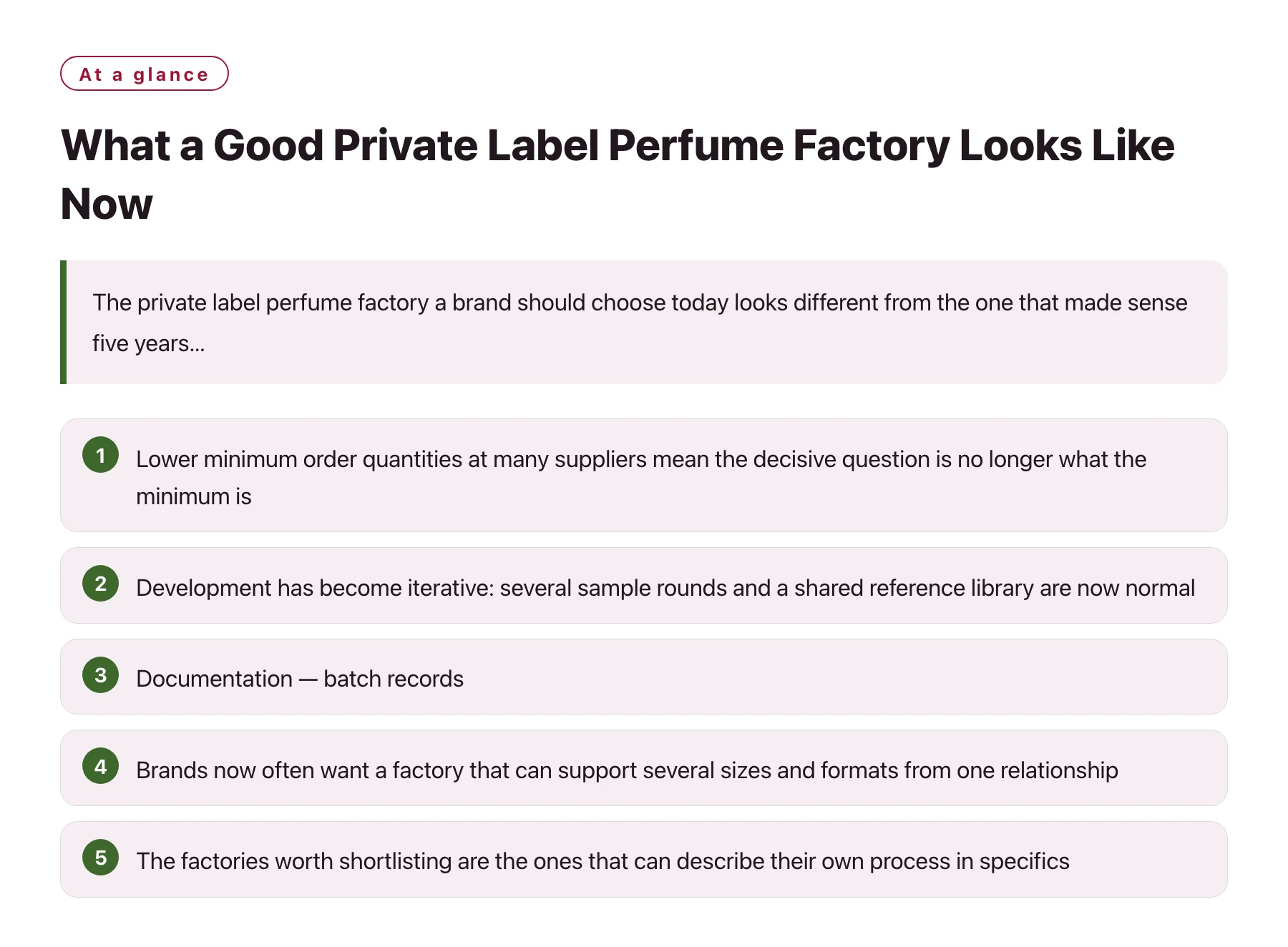
Key takeaways
- Lower minimum order quantities at many suppliers mean the decisive question is no longer what the minimum is, but whether the line can be scheduled economically at that minimum.
- Development has become iterative: several sample rounds and a shared reference library are now normal, which changes how a factory should be evaluated.
- Documentation — batch records, safety data, allergen information — is increasingly expected as part of the standard delivery rather than as a special request.
- Brands now often want a factory that can support several sizes and formats from one relationship, so component flexibility has become a selection criterion.
- The factories worth shortlisting are the ones that can describe their own process in specifics; a tour of the process is more informative than a certificate list.
Private label used to mean a narrow arrangement: pick a scent from a fixed list, pick a bottle from a catalogue, apply your label, and accept the factory's minimum. That model still exists, and it still works for some products. But it is no longer the only model, and the alternatives have changed what a buyer should be looking for.
Two forces drove the change. On the supply side, more factories have built development capability and become comfortable with smaller runs. On the demand side, a wave of independent fragrance brands has created a market for private label products that do not look or smell like a catalogue item.
The result is that the selection criteria have shifted from capacity and price toward process, flexibility and documentation. This article sets out what that looks like in practice.
Minimums came down, and the question changed with them
A lower minimum order quantity is only useful if the factory can run the order without treating it as an inconvenience. The more revealing question is what happens to the price, the lead time and the attention a small order receives. A supplier with a low minimum and a two-month scheduling window for small runs is offering a different proposition from one that batches small orders into a regular production slot.
It is worth asking how small orders are scheduled, not only how small they can be. Some factories group small runs of similar packs on the same line, which keeps the unit cost reasonable; others prefer to fold a small order into a gap in a larger schedule. Either approach can work, and knowing which one you are buying tells you how firm your delivery date really is.
Ask what the minimum is not
Some minimums are driven by the concentrate, some by the bottle, and some by the label print run. A factory that can tell you which component sets the floor is revealing how well it understands its own cost structure, and it also tells you which part of your product to redesign if the minimum is too high.
Then and now: what buyers are looking for
| Selection criterion | The older expectation | What buyers ask now |
|---|---|---|
| Scent choice | A fixed catalogue of ready scents | A brief-led development process with revision rounds |
| Order size | One high minimum, take it or leave it | A stated minimum plus an explanation of what drives it |
| Bottle | A small range of stock shapes | Stock plus the option of custom decoration or a new mould |
| Documentation | Provided on request | Issued as part of the release pack by default |
| Communication | One sales contact | Direct access to the technical or development team |
| Repeat orders | Re-quoted from scratch | Formula and pack specification held for reordering |
The bottom two rows are the ones brands mention most often when they explain why they changed suppliers. Losing the technical thread between orders costs more time than a slightly higher unit price.
Why documentation moved to the centre
Fragrance sits inside a regulated product category in most markets, which means the paperwork is not optional. A private label factory that treats documentation as a standard output — safety data sheet, conformity statement, allergen declaration, batch record — is easier to work with than one that treats each document as a favour.
The trend is visible across the category. Market research publishers such as Mintel have documented how fragrance has broadened as a consumer category, with launches spreading across price points and channels, and that breadth has brought more brands into contact with regulatory expectations they had not met before [1]. Trade coverage of the beauty industry has followed the same shift, reporting on how supply chains have had to become more transparent as the number of small brands has grown [2].
For a buyer, the practical test is simple: ask which documents arrive with an order and which have to be requested. The answer says a great deal about how the factory organises its process.
The reference sample is now a shared asset
Older private label relationships were often approved on the basis of a catalogue sample that both sides kept informally. The current expectation is a retained reference with a batch code, held by both parties, which is what makes a repeat order straightforward and a dispute resolvable. This is one of the clearest differences between a factory that is set up for brands and one that is set up for one-off sales.
Flexibility across sizes and formats
A brand that launches one 50 ml bottle will eventually want a 10 ml travel size, a discovery set, a refill, or a home fragrance in the same scent family. Whether that is easy or painful depends almost entirely on decisions made during the first order, and on whether the factory was chosen with a range in mind.
The practical questions are whether the same concentrate can be used across formats, whether the closure can be shared between sizes, and whether the factory can fill both alcohol-based and other formats. A supplier that is comfortable with a range will usually say so plainly, because it is a capability rather than a promise. It is also worth asking about the scent itself: private label fragrance production across several formats raises questions about dosage and performance that are best raised before the first size is locked.
For buyers who are still building the brand concept rather than sourcing a specific product, the sequence of decisions matters as much as the factory choice, and it is set out in more detail in Xuelei's guide.
One habit makes the choice easier: a shortlist of three factories is usually enough, and it is worth sending the same brief to all three. The differences in how they respond — the questions they ask, the scope they quote, the documents they assume — will tell you more about fit than any brochure, and it turns the comparison into a matter of evidence rather than impression.
What still separates a good factory from an average one
Two things have not changed. The first is that the good factories can describe their own process in specifics: where the concentrate is compounded, how fill weight is controlled, what triggers a batch to be held, who signs off a release. A buyer who asks for that description will get either a real answer or a tour of generalities, and the difference is obvious within a few minutes.
The second is that the relationship is easier when expectations are written down early. Scope, ownership of the formula and the mould, the retained sample and the document list are the same four items that a brand should settle with any manufacturer, private label or not. Taken together they are a working definition of what a good private label perfume factory looks like today: one whose scope, ownership terms, sample reference and document list can all be stated plainly. On a small first order they take an hour to agree and they prevent most of the problems that would otherwise surface later.
Sources
- Mintel Press Centre —— Mintel's press releases on consumer and beauty market research, including fragrance and personal care trend reporting.
- Cosmetics Business —— A trade publication covering the beauty and cosmetics industry, including fragrance launches and regulatory developments.
Frequently asked questions
What does private label mean for perfume?
It generally means the brand applies its own name and packaging to a product that the factory already knows how to make, sometimes with a modified scent. The distinction from a fully custom project is how much development the brand commissions and who owns the resulting formula.
Are private label perfume minimums still high?
At many suppliers they have come down, though the floor is usually set by one component rather than by the fragrance. Ask which component determines the minimum, because that tells you whether a different bottle or label could lower the entry point.
How many sample rounds should a private label factory include?
Two or three is a common allowance. What matters more is whether the rounds are documented and whether the final approved sample is retained with a batch reference, since that reference governs every later order.
Should I choose a factory that already has scents I like?
It can shorten the project considerably, and it is a legitimate route to market. The trade-off is exclusivity: a scent that already exists may be used for other clients, so ask directly whether the direction you select can be reserved for you.
How do I check a factory's quality claims?
Ask for the scope of the certifications, the issuing body, and a walk-through of a batch record from raw material intake to release. Certificates describe a system that was audited; a batch record shows what happened on a specific run, which is the more useful document for a buyer.